
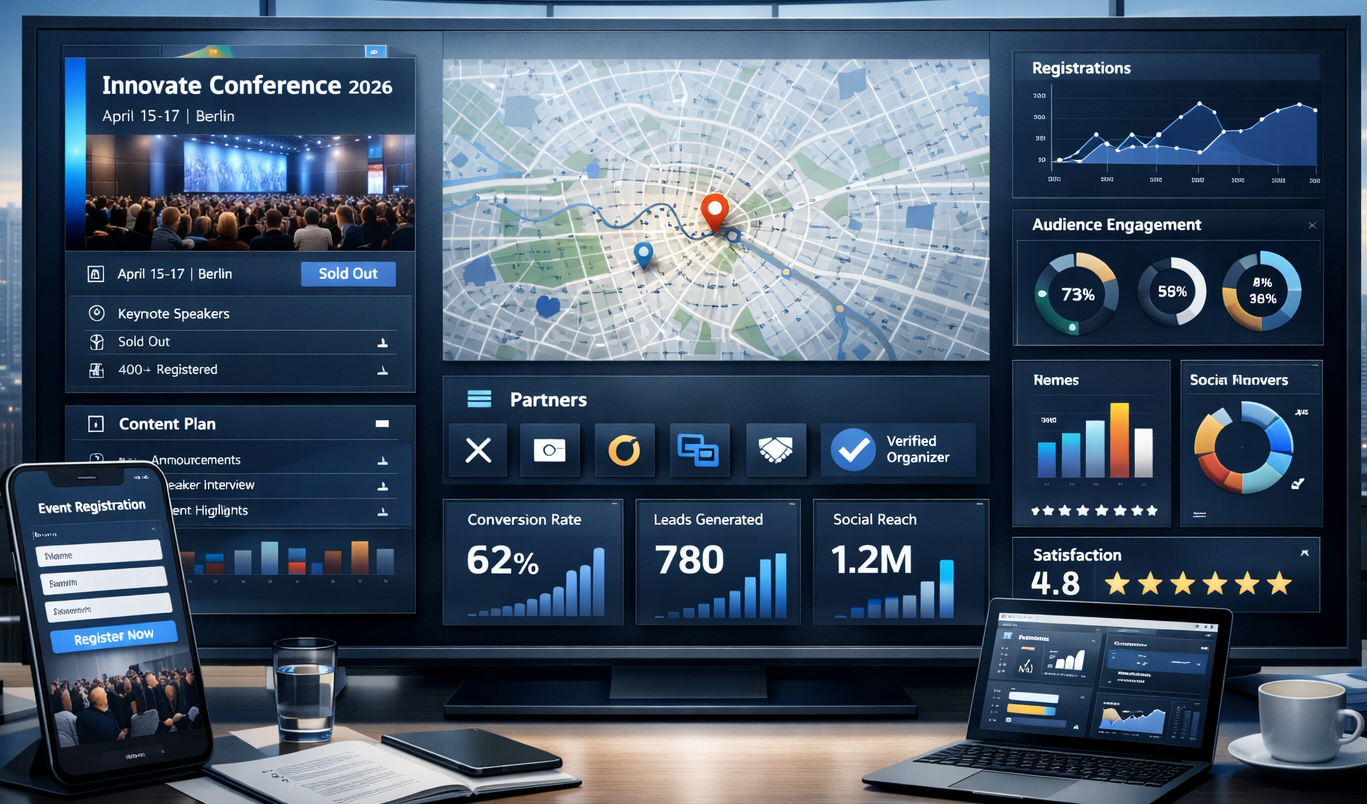
The event industry in 2026 is moving
toward greater precision, manageability, and practical value. Guests are no
longer satisfied with just a “beautiful event,” and organizers are no longer
satisfied with simply good attendance. What comes to the forefront are audience
quality, a smooth user journey, measurable results, and the ability of an event
to live beyond a single day.
Which approaches will be especially
important in 2026? Let us look at the key trends that organizers, brands, and
venues should pay attention to.
1. Narrow segmentation instead of
trying to appeal to everyone
In 2026, the winners will not be the
most “mass-market” events, but those that understand their audience with real
precision. The more clearly an organizer can answer the question “who exactly
is this event for?”, the higher the chance of strong engagement, targeted
registrations, and meaningful feedback.
What this means in practice:
- programs tailored to specific professional roles and interests;
- events for niche communities and specialized markets;
- personalized communication before, during, and after the event.
Why it works:
People are more willing to attend when they feel that the content, atmosphere,
and participant mix have truly been created for them.
2. The event as a media product, not
a one-off date on the calendar
In 2026, a strong event is not just
the day it takes place. It is a full content cycle: announcements, interviews,
backstage materials, pre-event content, live activity during the event, and
post-event reach.
What is expected to be on trend:
- a series of publications before the event;
- content opportunities for social media and partner media;
- post-releases, photos, videos, speaker quotes, and takeaways after
the event;
- building a digital footprint that continues to work for the brand
long after the event ends.
Practical conclusion:
An event should not simply happen — it should leave behind informational
capital.
3. The simplest possible user
journey
One of the main trends of 2026 is
the drive to reduce friction at every stage. If it is difficult for a person to
understand the format, location, participation terms, or registration process,
they leave.
What
becomes critically important:
- a clear event card;
- clear dates, location, format, and registration terms;
- a convenient mobile version;
- fast publishing and easy editing for organizers;
- as few unnecessary steps as possible before the target action.
Main idea:
The simpler the journey from first touchpoint to registration, the higher the
conversion rate.
4. Measuring results instead of
saying “it went well”
In 2026, people will increasingly
ask not “how many people came?” but “what result did this produce?” This is
especially relevant for brands, partners, sponsors, and B2B organizers.
What they will look at:
- the number of targeted registrations;
- audience quality;
- content engagement;
- website visits, applications, and leads;
- reach and duration of post-event visibility;
- returning attendees at future events.
What matters for organizers:
Already at the preparation stage, it is important to understand which metrics
will define success and to build the event mechanics around them.
5. Local relevance with a global
presentation
A website, brand, or organizer may
work with an international audience, but the winners are those who preserve
local accuracy. In 2026, adapting events to a specific city, market, language,
and cultural context will be especially valued.
What
this includes:
- multilingual event
presentation;
- precise work with location and the local agenda;
- partnerships with local communities and venues;
- correct presentation of information for an international audience.
Why it matters:
Global reach alone is no longer a competitive advantage. What matters is being
understandable and relevant to a specific audience.
6. Partnered and co-branded events
as a growth tool
In 2026, more and more events will
be built not around a single organizer, but at the intersection of brands,
communities, media, and venues. This reduces acquisition costs, strengthens
trust, and expands audience reach.
What will be especially in demand:
- joint events between two brands;
- collaborations between a brand and a professional community;
- partner programs with venues and industry media;
- cross-promotion with mutual amplification of reach.
The advantage of this approach:
Each partner brings its own resource — audience, reputation, expertise, or
distribution.
7. Trust, transparency, and safety
as part of event value
In 2026, users are paying closer
attention to whom they share their data with, how honestly an event is
described, and what they can expect from participation. Reputation is built not
only through visuals, but also through transparency.
What
becomes important:
- clear registration and participation rules;
- transparent information about the organizer;
- careful handling of personal data;
- honest descriptions of the program and conditions;
- a predictable user experience without unpleasant surprises.
Conclusion:
Trust is increasingly becoming a factor that directly affects conversion.
8. Compact, manageable events with
high efficiency
In 2026, the focus is shifting from
the idea that “bigger is better” to the model that “the more precise and
efficient, the stronger the result.” Not every event needs to be large-scale.
In many cases, a more compact format delivers better engagement and a
higher-quality audience.
What
this means:
- fewer random attendees;
- more meaningful interactions;
- better program manageability;
- higher-quality communication between the brand and guests.
A signal for organizers:
It is not always necessary to chase scale. Sometimes precision works better
than size.
Conclusion
Events in 2026 are not just about
attractive production or an interesting program. They are about precise
audience work, a convenient user journey, measurable business impact, strong
content packaging, and trust in the organizer.
The winners will be those who know
how not just to gather people, but to create events that:
- are easy to find;
- are easy to attend;
- are worth talking about;
- and continue working for the brand even after they are over.
If you are planning events in 2026,
it makes sense to look more broadly: not only at the scenario of the day
itself, but at the entire event journey — from the first publication to the
digital footprint it leaves behind.
No comments yet. Be the first to comment!