
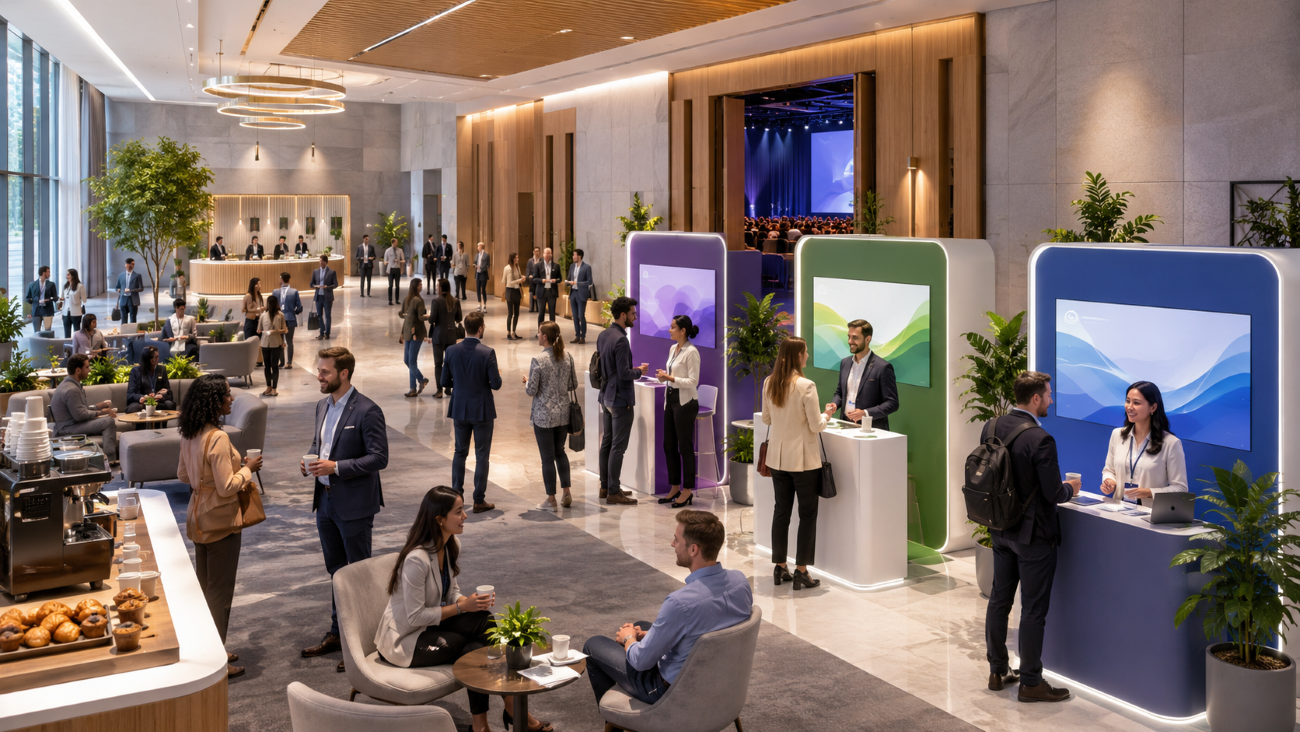
Partner and sponsor booths are often perceived as a secondary element of an event: they set up a table, a banner, and a couple of brochures—and that's it. But in practice, booth placement determines many things: how well the partner connects with the audience, how engaged guests are, and whether the entire area looks like a random exhibition within the event.
A well-placed booth serves several purposes: it gives the partner visibility, helps attendees learn about useful products or services, enhances the atmosphere of the event, and doesn't interfere with the main program. A poorly placed booth, on the other hand, can irritate guests, create traffic jams, look out of place, and leave the partner feeling like their participation was a formality.
Let's look at how organizers should properly consider partner placement and the most common mistakes.
You shouldn't start with the location, but with the partner's purpose.
The main mistake is placing booths as an afterthought. For example, "there's some free space here, let the partners stand there." This approach rarely yields good results.
Before choosing a zone, you need to understand why the partner is participating in the event. Does the partner need sales? Leads? Awareness? Product demonstrations? Communication with a specific category of guests? Photo and video content? Different goals require different placements.
If a partner needs to conduct short consultations, they need an area where they can quietly converse. If they're demonstrating a product, they need a location with ample space and access to electricity. If the goal is maximum brand visibility, the booth should be in the natural flow of guests, not in a remote corner.
The booth shouldn't just be "somewhere on the floor." It should be located where the partner has the opportunity to accomplish their goal.
The booth should be in the way, but not obstruct traffic.
The best locations for partner booths are usually near natural touchpoints: registration, coffee breaks, the hall entrance, cloakrooms, networking areas, or the waiting area.
But it's important not to confuse visibility with obstruction. Placing a booth too close to registration can create a queue and create frustration. If placed near a narrow aisle, guests will walk around it rather than interact. If placed directly at the entrance to the main hall, people may perceive them as an obstacle.
A good location is a point where attendees naturally slow down. For example, while waiting for coffee, chatting during a break, checking the program, checking the schedule, or in the networking area. At this point, they have a few minutes of attention, and interaction with their partner feels natural.
The partner area should be part of the event, not a random addition.
Booths often look bad when they're simply "added on" to the event. The main hall is decorated in one style, the welcome area in another, and the partners stand with different banners, tables, roll-ups, and brochures without a common theme.
The organizer should establish basic rules in advance: acceptable booth sizes, branding format, banner placement, visual requirements, the presence of promotional materials, the behavior of partner representatives, and the use of sound, lighting, or screens.
This doesn't mean that all booths have to be identical. But they should visually complement the event. If the event is business-like and premium, aggressive promotional booths with numerous posters can ruin the impression. If the event is creative and informal, a too-stiff corporate booth can look out of place.
The partner area should support the atmosphere of the event, not detract from it.
Every booth should have a reason to stop.
Another common problem is that there's a booth, but attendees don't understand why they should approach it. Brochures are lying on the table, a partner representative is standing nearby, but there's no reason to initiate a conversation.
A good booth should answer a simple question: what will attendees gain by stopping for a minute or two?
This could be:
- a quick consultation;
- a mini-product demo;
- a useful checklist;
- a test or diagnostic;
- a promo code;
- a short activity;
- a registration gift;
- an opportunity to ask an expert a question;
- an interactive screen;
- a photo zone;
- a quick case study.
Without such a reason, the booth becomes a decoration. People may see it, but they won't interact with it.
You can't treat all partners equally if the packages are different.
If an event has multiple partnership levels, this should be reflected not only in the logos on the website but also in the placement on the site.
A general partner, a strategic partner, and a small media partner should not receive equal visibility if the terms of participation are different. Otherwise, large partners will naturally ask: what did they pay more for?
Differences can include booth size, location, speaking opportunities, access to the registration database, on-stage mentions, placement in the welcome area, a separate activity, or integration into the program.
It's important to outline these terms in partner packages upfront. This will reduce disputes for the organizer and set clear expectations for the partner.
Common mistakes in booth placement
Mistake 1. Placing booths in a far corner.
If attendees have to specifically search for the partner area, most won't make it there, especially if the program is tight and breaks are short.
Mistake 2. Placing booths where people are in a hurry.
A walkway to the hall, a narrow corridor, or the area near the doors may provide visibility, but won't allow for meaningful interaction. People aren't willing to stop there.
Mistake 3. Not considering the flow of guests.
It's important for the organizer to plan the participant's route in advance: entrance, registration, cloakroom, coffee, hall, break, networking, and exit. Booths should be integrated into this route.
Mistake 4. Failure to provide partners with technical specifications.
Electricity, internet, tables, chairs, screens, roll-up space, and connectivity options—all of this must be coordinated in advance. Otherwise, on the day of the event, urgent requests and chaos will ensue.
Mistake 5. Overcrowding the space.
Too many booths in a small space create a marketplace feel. Guests become tired, aisles become narrow, and partners compete for attention.
Mistake 6. Failure to explain the rules of conduct to partners.
Hard-pressuring sales, loud music, aggressive leaflet distribution, and attempts to intercept guests at the entrance—all of this can ruin the impression of the event.
Mistake 7. Failure to link booths to the program.
If partners exist separately from the event, their role seems incidental. It's better when the partner area is logically linked to the event theme and the needs of the audience.
How to make the partner area useful for guests
The best option is when attendees don't perceive booths as advertising. They see them as an additional benefit of the event.
For example, at an HR conference, a partner might offer an express employer brand audit. At a fintech event, a demonstration of a payment solution. At an educational event, a training program selection. At a business forum, a short consultation on entering a new market.
The more closely the partner's activities are related to the event's theme, the higher the chance that guests will approach voluntarily.
The organizer should discuss with partners in advance not only "what you'll put on your stand," but also "what attendees can do with you." This changes the approach. The stand becomes not just a place to display a logo, but a point of interaction.
What should be determined in advance
To avoid conflicts on the day of the event, it's best to agree with each partner in advance on the following:
- exact location;
- size of the stand or area;
- setup and dismantling time;
- number of representatives;
- technical requirements;
- electricity and internet availability;
- acceptable branding formats;
- whether sound, screen, and lighting can be used;
- what materials can be distributed;
- Who is responsible for cleaning the area?
- What activities does the partner plan to conduct?
- How will results be measured?
It's especially important to coordinate the partner's activities. Sometimes, a partner comes up with an idea that doesn't fit the event format: a loud raffle, promoters in the aisles, an overly large structure, or a separate photo zone that takes up more space than planned.
All of this should be discussed before the event, not on the morning of the opening.
How to evaluate results after an event
Booth placement doesn't end with dismantling. After the event, the organizer should collect feedback from partners: how many contacts were made, were there relevant guests, was there enough traffic, was the location convenient, and what could be improved.
This helps avoid repeating mistakes at future events. For example, it might turn out that the area was beautiful, but guests rarely visited it. Or that the coffee area had good traffic flow, but was too noisy for consultations. Or that the partner didn't need more space, but rather better inclusion in the program.
This type of analysis is especially important if the organizer plans to develop partner packages and regularly attract sponsors.
Conclusion
Partner booths are more than just tables with logos. They are part of the event architecture. Their placement determines whether partners receive real benefit and attendees receive added value.
A good booth is located at the right point along the route, doesn't interfere with traffic, matches the atmosphere of the event, and gives guests a clear reason to stop. A poorly designed booth sits "wherever there's space left," looks haphazard, and doesn't help either the partner or the audience.
If the organizer wants sponsors to return for future events, it's important to treat their placement as a full-fledged part of the event design—not as a technical task, but as a tool for interaction between the brand, the event, and the audience.
Do you plan partner areas at events in advance, or do you place booths after the main layout of the venue has been approved?


No comments yet. Be the first to comment!