
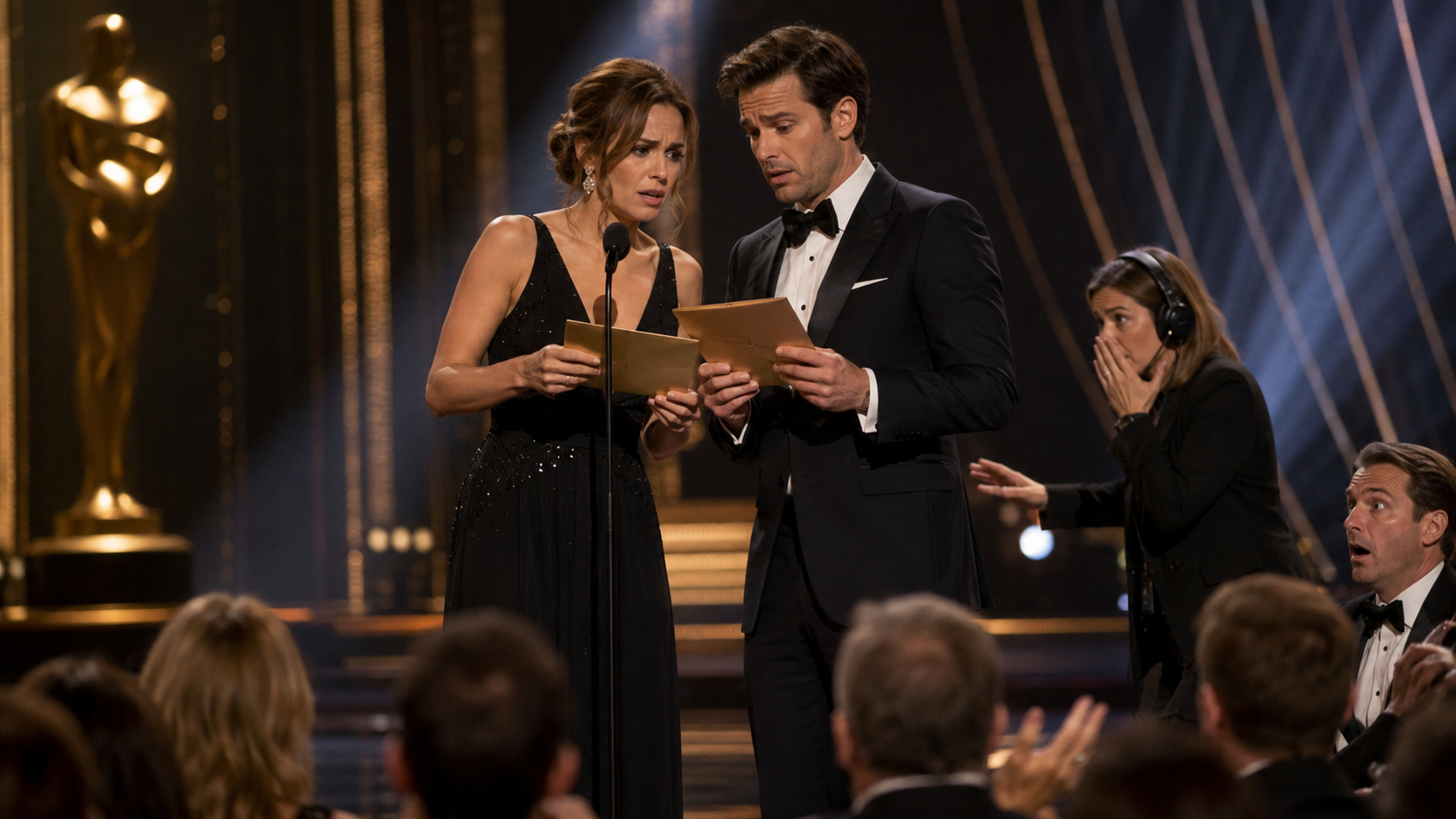
At the 2017 Academy Awards, La La Land was announced as the Best Picture winner, and the team took the stage and began their acceptance speech. But a few minutes later, it became clear that Moonlight was the real winner. The reason was simple and almost absurd: hosts Warren Beatty and Faye Dunaway were given the wrong envelope—it contained a card for the wrong category. PwC, which was responsible for the envelope process, officially apologized and acknowledged that the presenters had mistakenly received the wrong envelope.
The comical nature of the situation lay in its contrast. On stage was the world's most prestigious film event, tuxedos, millions of viewers, and the final award of the evening. Yet the mistake seemed almost mundane: "they gave me the wrong envelope." However, the consequences were anything but mundane: the wrong team managed to take the stage, begin their speech, and then hand the award to another team live on air.
What were the errors?
1. A critical process depended on manual transfer.
Even if the overall system was in place, final control turned out to be tied to a single physical action: the right envelope had to be in the right hands at the right moment. This is a weak point for any event.
2. The instant stop signal failed.
According to ABC News, the error was quickly realized, but the fix took time—so long that the La La Land team managed to finish part of the acceptance speeches. This is a key lesson for live events: it's not enough to know that an error has occurred. You need a pre-established protocol for who, how, and when stops the action on stage.
3. Duplicating resources created not only protection but also risk.
The system had two cards for each category, and two PwC representatives handled the envelopes. The idea of duplication is reasonable, but if the backup process is poorly separated from the main one, the backup can become a source of error rather than a safety net. ABC News noted that PwC created two cards for each category.
4. The reputational risk turned out to be greater than the technical one.
The error was effectively corrected. But the public impact was enormous: participants, hosts, organizers, the contractor, and the very perception of the ceremony suffered. The Academy specifically stated that the experience of the La La Land and Moonlight teams was "profoundly altered" by this error.
A Unique Feature of the Case
This case is not about "poor organization" in the usual sense. On the contrary, it demonstrates that even a mature, expensive, and repeatedly tested system can fail due to micro-actions at the intersection of people, time, and protocol.
For event organizers, the key takeaway here is this: the higher the status of the moment, the less it should depend on improvisation.
Conclusions for Event Organizers
Critical moments require not only checklists but also control points: who checks, who confirms, who has the authority to stop the scene.
Backup processes must be physically and procedurally separated from the main flow, otherwise the backup set can create confusion.
A live event should have a short crisis protocol: what to do if the wrong name is announced, the wrong winner, the wrong slide, the wrong speaker takes the stage, or there's a script error.
And most importantly: participants are more likely to forgive the error itself than a poorly managed pause after it. Mistakes can be human. The chaos that follows is organizational.
What funny, comical, or awkward moments at events do you remember?


No comments yet. Be the first to comment!