
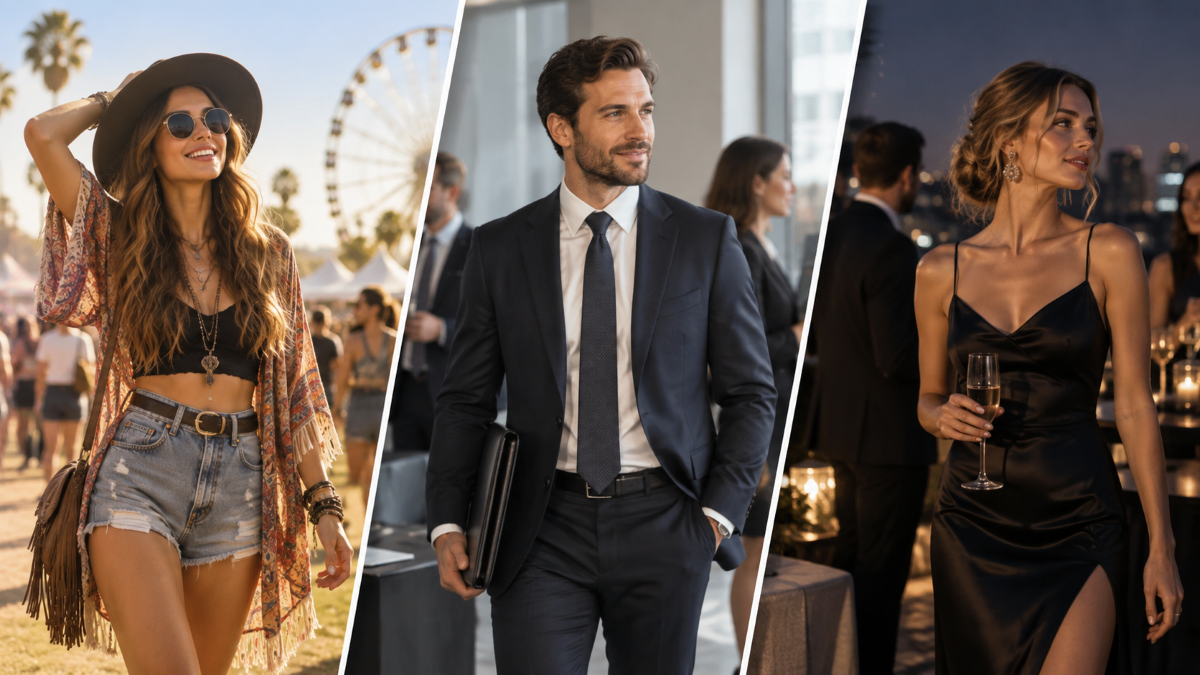
The question "what to wear?" arises before almost any event—from a conference and business breakfast to a festival, exhibition, or evening reception. And it's not just about appearance. Inappropriate clothing can make several hours of the event physically uncomfortable: overly formal shoes at a festival, a heavy suit at an outdoor event, or, conversely, an overly relaxed look at a meeting where most guests are dressed in business formal.
Furthermore, relying solely on the event's title isn't enough. A "conference" could be held in a five-star hotel or a creative space. A "party" could mean a cocktail reception or an outdoor festival for several thousand people.
Therefore, it's better to choose your outfit not based on a single word on the poster, but on a combination of several factors.
First, consider the format of the event.
The first question is: what will you be doing at the event?
If you'll be sitting in a conference room for most of the time, you can afford a more structured and formal look. If the program involves several hours on foot, moving between venues, or active networking, comfort becomes just as important as appearance.
For a festival or large outdoor event, footwear, weather, and the ability to quickly adapt to the temperature are especially important. A good look here is one you can wear for several hours, not just for the first twenty minutes.
At an exhibition or conference, it's important to consider the amount of movement. A huge exhibition center combined with new, stiff shoes can change the impression of even a great event.
At a business meeting, however, the logic is different: clothing becomes part of the professional communication. It's better to look slightly more put-together than noticeably less formal than the other attendees.
A dress code is more important than guesswork.
If the organizer specifies a dress code, it's best to treat it as a helpful hint rather than a formality.
The problem is that classic designations aren't clear to everyone. The difference between Formal, Business Formal, Business Casual, and Smart Casual is obvious to those who regularly attend such events, but for many guests, these definitions remain rather abstract.
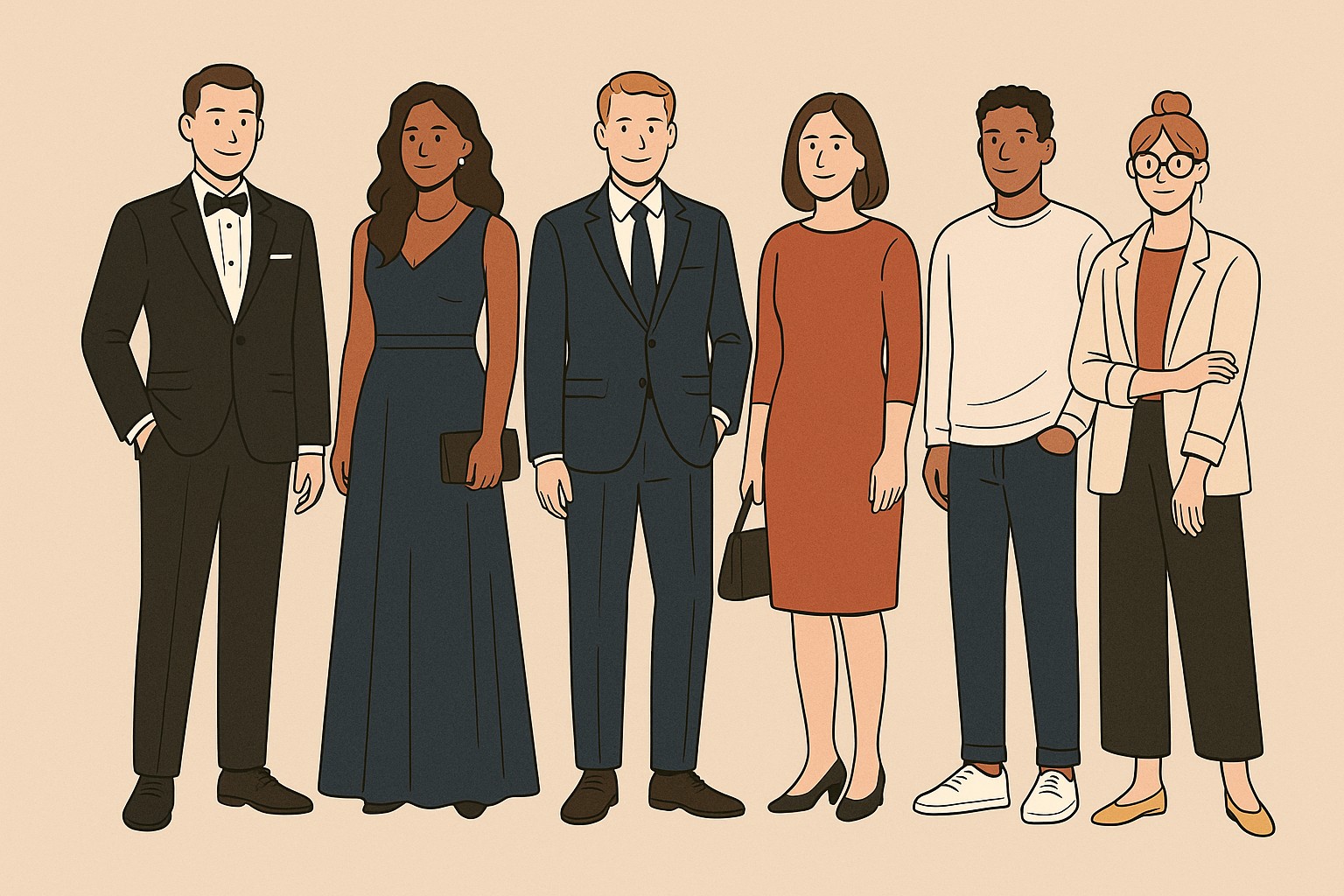
Syampya uses a system of custom naming conventions with familiar classic equivalents. For example, Crown Affair corresponds to White Tie/Ceremonial, Noir Tier to Black Tie, Sharp Standard to Formal/Business Formal, and NeatSya to Business Casual.
More casual formats are also separated: Urban Ease corresponds to Smart Casual, SparkSya to Cocktail/Social, Mood Lab to Creative/Themed/Fashion-forward, and Syampya Freeform to Casual/Relaxed.
Logic here is useful not only as a platform element. The organizer effectively translates the abstract dress code into more understandable language and immediately displays its classic equivalent. This two-level format is also recommended for the interface - first the Syampya name, then the classic designation.
What do the main levels mean in practice?
You can use a very simple guideline:
• Crown Affair / White Tie / Ceremonial - the most formal events, ceremonies, and official receptions.
• Noir Tier / Black Tie - evening gala dinners, awards ceremonies, and formal receptions.
• Sharp Standard / Business Formal - business forums, official conferences, and high-level meetings.
• NeatSya / Business Casual - conferences, business breakfasts, and professional networking events without the formal attire requirement.
• Urban Ease / Smart Casual - city events, presentations, networking events, and some exhibitions and more casual conferences.
• SparkSya / Cocktail / Social - parties, openings, and cocktail receptions.
• Mood Lab / Creative / Themed - fashion, art, and creative events, as well as events with a specific theme.
• Syampya Freeform / Casual / Relaxed - festivals, outdoor events, and the most informal events.
Even within the same level, differences remain. Business casual attire for a financial conference and business casual attire for a tech startup event may look different.
Business Event: Not Necessarily a Formal Suit
One common mistake is to assume that every business event requires a formal suit.
At a conference, industry trade show, or networking event, business casual or smart casual are often more appropriate. For example, trousers, a shirt or a simple top, a jacket, a simple dress, and loafers or other smart shoes.
But there is an important exception. If the event involves government agencies, finance, the legal sector, official delegations, or high-level negotiations, a more formal option is usually safer.
It's also worth considering the time of the event. A morning business breakfast and an evening reception after the conference may require completely different levels of formality.
Festival: First the Environment, Then the Look
At a festival, it's much easier to make a mistake not with style, but with practicality.
You need to check whether the event is indoors or outdoors, whether there's a lawn or a field, how much walking you'll have to do, when the program ends, and how much the temperature changes in the evening.
For outdoor events, the layering principle is especially useful: wear something you can take off during the day and put back on in the evening.
Footwear is crucial here. If the event involves many hours on your feet, a comfortable pair will almost always be a better choice than flashy but impractical shoes.
And another consideration: the bag. At a festival, a small crossbody or compact bag is usually more convenient than a large tote bag, especially if you'll be constantly moving.
Cocktail, Party, or Opening
Here, you can allow yourself more individuality.
Cocktail/Social doesn't necessarily mean an evening dress and heels. The modern cocktail format is much broader: an interestingly cut suit, a midi dress, statement accessories, a silk blouse, and unusual shoes.
The key is to ensure your look is deliberately formal or social, not casual after-work attire.
If the event is labeled as Creative or Themed, on the other hand, excessive caution can come across as boring. In this case, the organizer is essentially giving you permission to experiment.
If there's no dress code specified at all, then you'll have to gather a few clues yourself.
Look at the venue. A hotel, gallery, rooftop, exhibition center, restaurant, and city park all set different levels of formality.
Pay attention to the time. Daytime events typically allow for more relaxed attire. Evening events often call for a more put-together look.
Look at the program. Panel discussions, business meetings, and negotiations require one approach. A concert, party, or open-air event requires another.
It's also helpful to look at photos of previous events by the same organizer. This is one of the most reliable ways to understand the actual audience and the level of formality. And if doubts persist, a simple principle applies: it's better to choose a neutral look, which can be slightly elevated or de-emphasized in formality with the help of a jacket, shoes, or accessories.
Organizers should also help guests.
Uncertainty about attire isn't just an attendee's problem. It's part of the event experience.
A statement like "Dress code: Smart Casual" is better than no information. But even more helpful is providing some context: will the event be held on an open terrace, will part of the program be outdoors, will there be a lot of movement, or, conversely, is a formal evening reception planned?
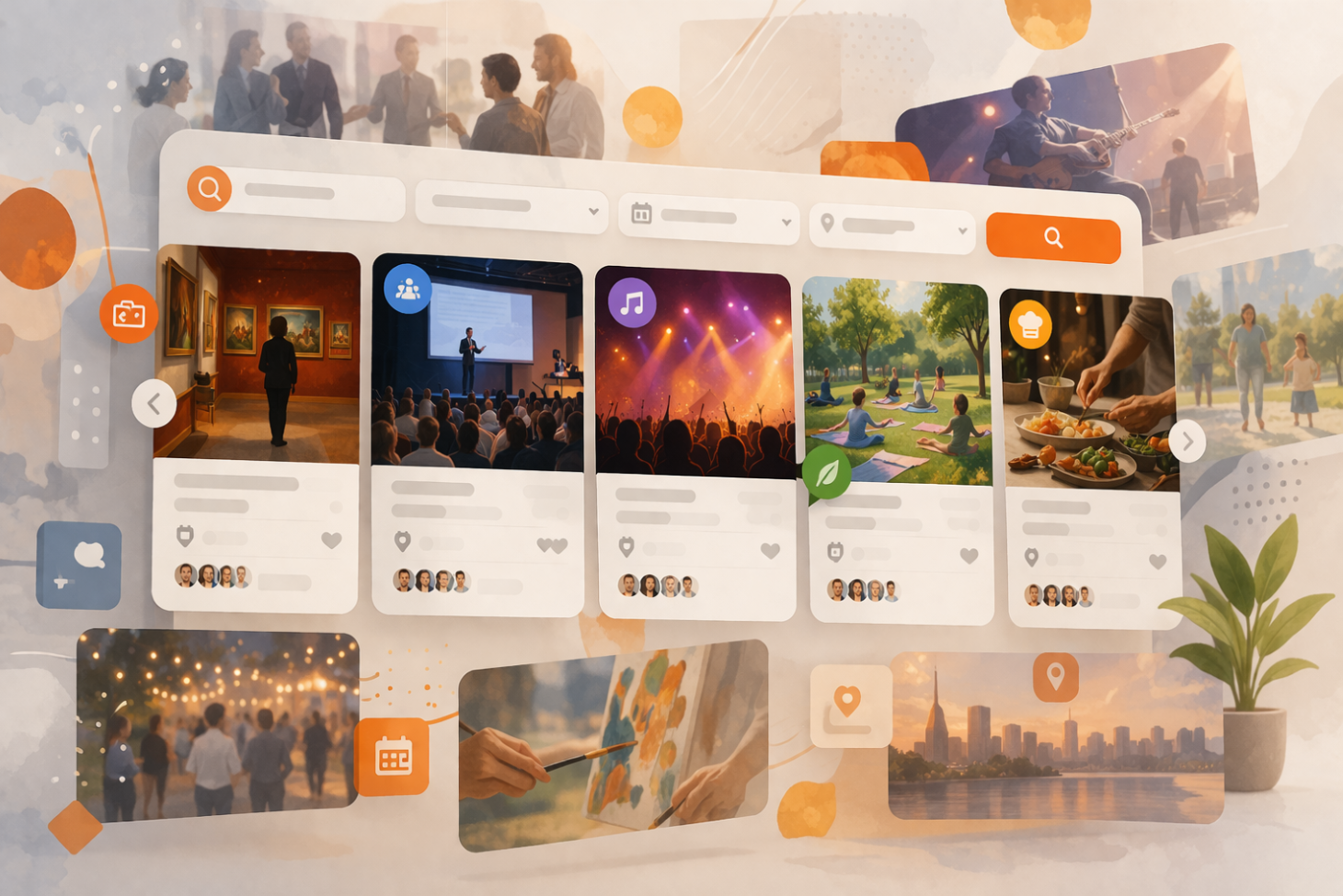
This is why it makes sense to include the dress code next to the main event information on the event card. On events.syampya.com, this can be done through Syampya's level system with classic equivalents—guests receive not only a beautiful name but also a familiar category, making it easier to choose an outfit.
For the organizer, this is a small detail. For the attendee, it's one less question to ask before the event.
Comfort is also part of the dress code.
Sometimes people try to adhere so closely to the format that they forget about their own comfort.
But the right outfit for an event should be able to withstand the reality of the evening or day.
If you have four hours of networking, your shoes should be able to stand for four hours. If the conference is held outdoors in the summer, the fabric should be appropriate for the temperature. If the event ends late in the evening, it's worth considering a top layer.
Good event attire isn't the most striking image you see in the mirror before you leave. It's a look that still works three, five, or eight hours later.
Key Rule
There is no universal formula for event attire.
The best guide is a combination of the format, venue, time, program, and the specified dress code.
At a business meeting, professional appropriateness is important. At a cocktail party, the social context. At a festival, comfort and the environment. At a themed event, a willingness to support the organizer's vision.
And the more clearly the organizer explains expectations upfront, the less guesswork guests have to do.
Ultimately, a good dress code doesn't restrict attendees. It provides context—and allows them to arrive at the event feeling like they're dressed just right.

No comments yet. Be the first to comment!