
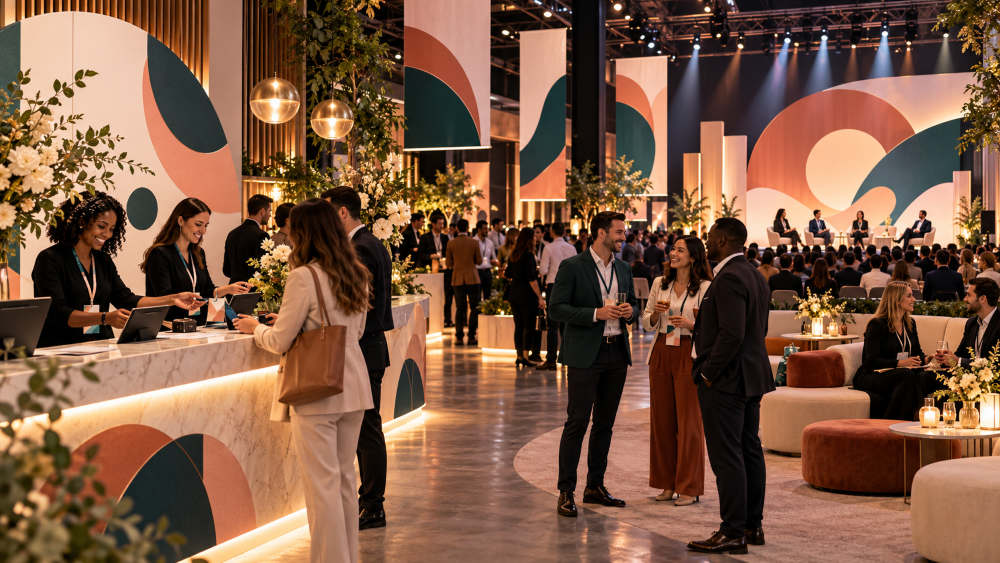
Why are some events forgotten within a few days, while others are anticipated for a whole year? It's not always about scale, renowned speakers, or an expensive venue. Often, the difference lies in whether an event has its own recognizable character.
When people think of an event brand, they typically think of a logo, corporate colors, beautiful banners, and social media design. But this is only the surface. A true brand is formed by what the event promises to the audience, the emotions it evokes, how it communicates with attendees, and the impressions it leaves behind.
Let's explore what makes up an event brand and how to ensure guests remember more than just the date and location.
A Brand Starts with a Promise
Every successful event has a reason why people want to attend. And that reason isn't necessarily related to the program.
For example, one business conference promises attendees a serious professional discussion and access to experts. Another emphasizes informal networking, new connections, and the exchange of ideas. A third brings together a small community of people from the same industry, where each attendee feels part of a professional circle. All three events may be dedicated to the same topic, but perceived in completely different ways.
Therefore, the first question when creating an event brand is: what exactly should people expect when they see its name?
This could be:
• Access to a professional community;
• New knowledge and practical experience;
• Inspiration and unusual experiences;
• High-quality networking;
• Entertainment and emotional recharge;
• Introduction to new products, technologies, or ideas.
It's important not to promise everything at once. If an event tries to be a serious conference, a festival, and a fun party, it can be difficult for the audience to understand its nature.
A strong brand is built around a clear promise that the organizers can deliver.
Atmosphere is more important than a logo.
Imagine two events with the same program and even similar speakers.
At the first event, guests are greeted by friendly staff, registration is quick, the space is conveniently organized, the music matches the mood, and attendees easily get to know each other. The second event features the same presentations, but registration takes twenty minutes, navigation is unclear, there are awkward pauses between sessions, and the staff doesn't know the answers to simple questions.
Formally, the content is the same. But the overall experience will be completely different.
That's why a brand is created not only by a designer but by the entire organizing team.
The atmosphere is formed by many details: lighting, sound, decor, staff behavior, zone layout, the quality of the catering, and even how easy it is for guests to find the right room.
A good event brand should be evident in these details, not exist solely on promotional materials.
Tone of Communication: How the Event Speaks to the Audience
Every event has its own voice.
Some events communicate formally and reservedly. Others use humor, short messages, informal addresses, and lively language. Still others create the feeling of a closed professional club.
None of these approaches is universally correct. It's important to match the audience and the nature of the event.
For example, for an international investment forum, overly playful messages may seem inappropriate. For a youth music festival, dry corporate communications can make the event less appealing.
The tone of communication is evident literally everywhere:
• in announcements and promotional publications;
• on the event page;
• in emails after registration;
• in responses to participant questions;
• in announcements of program changes;
• in presenters' speeches;
• in thank-you letters after the event.
If the organizer communicates in a friendly and informal manner before the event, but at the venue, guests are greeted with a cold and overly formal atmosphere, a mismatch of expectations arises.
Consistent communication helps make a brand compelling.
Visual Recognition: More Than Just Colors
A brand's visual identity is truly important. But its purpose isn't simply to make the event beautiful; it's to help the audience recognize it among others.
To achieve this, it's helpful to use repeating elements: color palette, typography, photography style, graphics, presentation design, and navigation.
This is especially true for annual conferences, festivals, and industry forums.
If an event completely changes its visual style every year, it can be more difficult for people to connect the new event with their previous experience.
However, recognizability doesn't mean the design has to remain the same. You can update graphics, experiment with design, and adapt the style to a new theme while maintaining a few consistent elements.
A good example is when attendees recognize an event from a poster even before reading its name. A brand is formed even before registration.
The first impression of an event begins long before entering the venue.
A person sees the post, clicks the link, studies the description, looks at the program, and evaluates whether it's worth their time.
At this stage, not only the design but also the clarity of the information are important.
If a premium professional forum is promised, but the registration page looks sloppy, the program is described in general terms, and important organizational details are missing, trust is diminished.
Therefore, an event page is a valuable part of its brand.
For example, when posting an event on events.syampya.com, the organizer should pay attention not only to the title and date, but also to the description, visual design, and participant information. All these elements should convey the nature of the event and set the right expectations even before registration.
A good event card helps people understand not only where they're going but also what experience awaits them.
Don't promise what you won't deliver.
One of the most serious mistakes in event branding is the discrepancy between the advertising promise and the actual experience. For example, an event is marketed as an exclusive meeting with leading experts, but in reality turns out to be a mass presentation with minimal opportunity for networking.
Or the organizers promise active networking, but the program is so dense that participants have no time to get acquainted.
Or a festival is advertised as family-friendly, but the venue has virtually no infrastructure for parents with children.
Such inconsistencies are more damaging to the brand than a modest design or a small budget.
If the organizer promises an intimate atmosphere, the number of participants should be limited. If the main advantage is stated to be practical benefits, the program should include real tools and case studies. If comfort is promised, logistics and service must be carefully considered.
A brand becomes stronger not when the promise sounds good, but when the audience is convinced it can be trusted.
How to make an event recognizable year after year
For regular events, maintaining continuity is especially important.
This doesn't mean inviting the same speakers or repeating the program every year. Rather, it's important to maintain what keeps people coming back.
For a conference, this might be the specific quality of the discussions. For a festival, it might be the unique atmosphere and musical style. For a small business club, it might be the opportunity to connect with people with similar interests.
It's helpful to identify several consistent elements:
1. Main Idea. What value does the event provide to the audience?
2. Visual Character. What elements make the event recognizable?
3. Communication Style. How does the organizer communicate with guests?
4. Signature Experience. What do attendees gain from this particular event?
5. Ongoing Community. Why will people want to return?
Sometimes a very small detail becomes a recognizable feature: a traditional opening format, an unusual welcome area, a special networking session, or a final meeting of participants. The key is that this detail is relevant to the nature of the event, and not added solely for the sake of a striking photo.
How to tell if an event has a brand
The number of registrations alone doesn't indicate brand strength. People may buy tickets because of a specific speaker, a convenient date, or an advertising campaign.
It's much more interesting to observe other indicators.
Do attendees return to future events? Do they recommend the event to friends? Do they recognize its name without further explanation? Do they subscribe to next season's newsletter? Are partners willing to collaborate again?
It's helpful to ask guests a few simple questions after the event:
• What was most memorable?
• Did the event meet your expectations?
• How is this event different from others?
• Would you like to attend again?
The answers help us understand whether the image the organizer is trying to create matches the audience's actual impression.
If the organizer considers professional content the main advantage of the event, but guests remember only the beautiful venue, this is a reason to reconsider the positioning or program.
Conclusion
An event brand is more than just a name, logo, and corporate colors. It's a combination of promises, expectations, and impressions that shape the audience's attitude toward the event.
It begins with the initial announcement, develops during registration, is reflected in the atmosphere of the venue, and continues after the program ends.
A strong brand doesn't necessarily require a large budget. Consistency is far more important: a clear idea, a corresponding program, a recognizable communication style, and a real-world experience that backs up the organizers' promises.
Ultimately, a successful event isn't remembered because it took place on a specific day. It's remembered because it provided an experience that people want to repeat.
Which events have been so memorable to you that you still recognize their name or visual style even years later?
No comments yet. Be the first to comment!