
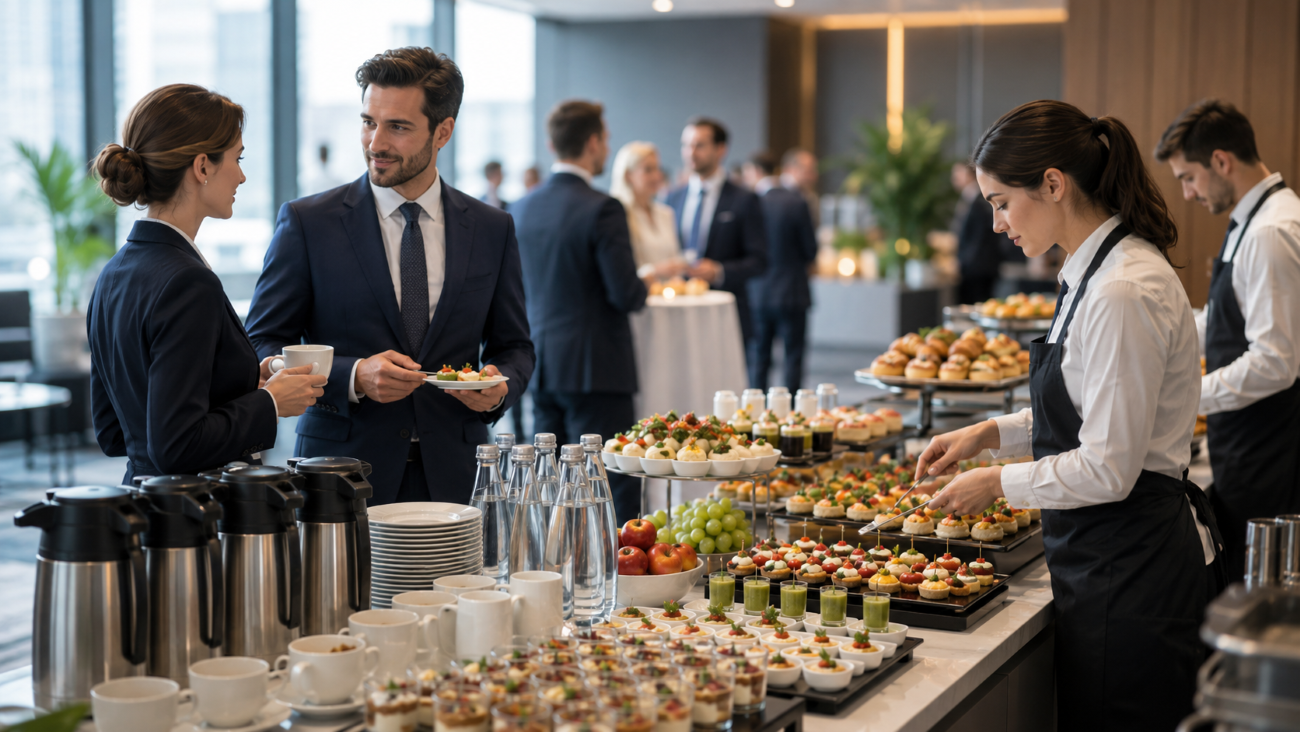
Catering at an event is often assessed too late – when guests are already queuing for coffee, the appetizers are gone, or half the food remains uneaten. In practice, catering is more than just "feeding the participants." It's part of the guest experience, a tool for audience retention, and one of the most sensitive budget items.
Good catering doesn't necessarily have to be expensive. But it must be well-thought-out: timing, format, portion sizes, logistics, audience type, and the actual economics of the event.
First the format, then the menu
The biggest mistake organizers make is starting with the food selection. A better starting point is asking questions:
- How long is the event?
- What time is it?
- Who is the audience?
- Will there be alcohol?
- Is there a business program?
- How many breaks?
- Will guests be seated or standing?
- Do you need to quickly serve a large flow of people?
A coffee break for 40 people, a business breakfast, an evening networking event, an all-day conference, and a premium reception – all have different objectives. The same menu can work well in one format and fail in another.
For example, at a business conference, speed, clarity, and neat presentation are important. At an evening networking event, ease of movement, the convenience of standing, and the opportunity to socialize are more important. At a private VIP event, food becomes part of the event's status, so presentation, staff, details, and food quality are all important.
Basic Portion Standards
These are not rigid standards, but working guidelines. They should be adapted to the length, audience, and timing of the event.
Coffee Break
For a short coffee break, the following is usually sufficient:
1-2 small appetizers or desserts per person;
coffee, tea, water;
sometimes juice or lemonade.
A good guideline for food is approximately 100-200 grams per person if it's a light break between program sections. If people arrive in the morning without breakfast, it's better to increase the amount.
Mini croissants, cheesecakes, yogurts, fruit, small pastries, and mini sandwiches work well for a morning coffee break. For an afternoon break, consider cookies, tartlets, fruit, light snacks, and small desserts.
Business Breakfast
If the event is in the morning and is advertised as a breakfast, the portion size should be more substantial. A guideline is 250-400 grams of food per person.
Dishes that are easy to eat without unnecessary complications are suitable: omelets, porridge, cheesecakes, croissants, mini sandwiches, fruit, yogurt, a cheese or vegetable platter.
It's a mistake to call an event a breakfast but only serve coffee and cookies. This can be irritating, especially if guests arrive before work.
Conference Lunch
If the event lasts all day, it's best to consider lunch as a full meal. A guideline is 400-600 grams of food per person, including a salad, main course, side dish, and a small dessert.
Here, not only portions but also the speed of service are important. If a single serving line serves 150 guests, even good food will be poorly received. People will remember the line, not the menu.
For business events, it's best to choose straightforward dishes: meat or poultry, fish or a vegetarian option, a neutral side dish, vegetables, or a simple dessert. Overly complex or experimental food increases the risk of some guests being dissatisfied.
Buffet
A buffet requires separate calculations. If it's a light welcome or a short networking event, you can plan on 5-7 small items per person. If the buffet replaces dinner, it's better to plan on 10-14 items per person.
It's important to understand the size of the item itself. One mini-canapé and one tartlet are not the same in terms of filling. Therefore, counting only "items per person" is insufficient. You need to consider the total weight, composition, and duration of the event.
For a buffet, convenient food is especially important: something you can pick up with your hand or a fork, eat in 1-2 bites, and avoid getting messy. Large, crumbly, runny, or complex dishes are not suitable for networking.
Drinks
Water should always be available. This is a basic standard, not an optional extra.
For a short event, you can plan on approximately 0.3-0.5 liters of water per person. For an event lasting several hours, plan on 0.5-1 liter per person. If it's hot, the room is stuffy, or there's a busy program, the volume increases.
Coffee and tea depend on the format. At business events, coffee is often consumed heavily, especially in the morning and afternoon. It's best to discuss with the caterer in advance whether coffee will be unlimited, per cup, or per station.
Catering Economics: What the Organizer Really Pays For
Catering isn't just the cost of the ingredients. The price typically includes:
- product procurement;
- preparation;
- delivery;
- packaging;
- equipment;
- tableware;
- linens;
- furniture, if needed;
- staff;
- setup and dismantling;
- logistics;
- contractor's markup;
- allowance for write-offs and waste.
Therefore, comparing offers solely on a per-person basis is incorrect. One contractor may include waiters, tableware, and delivery, while another may charge these separately. While the latter may be cheaper on paper, the final bill may be higher.
It's not a "menu versus menu" comparison that's important, but the overall cost of service.
Where money is most often lost
The first area of loss is an inflated number of guests. The organizer fears there won't be enough food and orders for everyone registered, even though the actual turnout may be lower. If the no-show is high, some of the food will simply go to waste.
The second area is too wide a selection. The more items, the more complicated the logistics and the higher the risk of leftovers. For most events, a compact but well-thought-out menu is better.
The third area is expensive but unnoticeable elements. For example, complex desserts that guests rarely eat, or premium ingredients that don't impact the overall experience.
The fourth area is incorrect serving time. If food is served too early, it loses its appeal. If it's served too late, guests become irritated. If the break is short, people don't have time to eat properly.
The fifth area is poor logistics. Insufficient serving lines, understaffing, inconveniently located stations, a lack of trash disposal, and a lack of water in the dining room—all of this can negatively impact the overall experience, even with a reasonable budget.
How to calculate food quantities
A basic calculation should take into account not only the number of registrations but also the actual expected turnout.
For example, if 200 people have registered, but experience shows that only 70-80% show up, it's not always necessary to order food for all 200. You can allow a reasonable buffer, but avoid paying for a large amount of food that will likely not be eaten.
Paid events typically have a higher turnout. For free events, a no-show can be significant. For corporate events, turnout depends on the company culture and the mandatory nature of participation.
A practical approach:
- First, determine the expected number of guests.
- Add a small buffer.
- Divide the food into stages: welcome, coffee break, lunch, and buffet.
- Calculate drinks separately.
- Check whether the venue can handle the flow of guests.
Don't skimp on water, coffee, and speed of service. These are basic things that greatly impact the overall experience.
Dietary Restrictions and Special Menus
Today, it's no longer enough for an organizer to simply order a "regular menu." They need to provide at least minimal alternatives:
- vegetarian options;
- pork-free dishes;
- light dishes without heavy sauces;
- the ability to note allergens;
- non-alcoholic beverages;
- sugar-free or low-sugar options, if appropriate.
It's not necessary to create a separate menu for each guest. However, it's important to ensure that someone with a common restriction isn't left without food.
A good practice is to ask about dietary restrictions on the registration form. However, it's important not only to collect information, but also to convey it to the caterer and incorporate it into the layout.
Food Serving and Placement
Even a good menu can be ruined by poor placement.
The coffee station shouldn't block the entrance. Buffet tables shouldn't be positioned in a narrow hallway. Water should be available not only near the food but also near the dining room. If there are many guests, it's better to have several serving stations rather than one beautiful but overcrowded station.
For events with a program, it's important that food doesn't interfere with the flow of people. Guests should easily understand where to go, where to get drinks, where to leave their dishes, and how to return to the hall.
If there are partner stands, the catering service shouldn't completely block them. Conversely, the stands shouldn't interfere with the coffee line.
What should be agreed upon with the caterer in advance?
Before the event, it's best to document in writing:
- the exact menu;
- the grams or number of items per person;
- the number of guests;
- stock;
- serving time;
- rmat;
- number of staff;
- equipment composition;
- tableware and linens;
- delivery, setup, and dismantling;
- venue requirements;
- leftovers handling procedure;
- cleaning responsibilities;
- the final price and what it includes.
It's especially important to clarify when the contractor should be on site. A caterer arriving 20 minutes before registration almost always poses a risk.
How to tell if your catering was a success
Good catering isn't necessarily remembered as a standalone event. Its quality is often demonstrated by the absence of problems: guests don't stand in long lines, there's plenty of food, drinks are readily available, dishes are cleared quickly, the staff is polite, and the area looks tidy.
After the event, it's helpful to evaluate:
- Were there any lines;
- Was there enough food;
- How much was left;
- Which items were eaten the fastest;
- Were there any complaints;
- Was there enough water and coffee;
- Did the staff cope;
- Was the menu appropriate for the audience;
- Was the budget justified.
This information helps you plan future events more accurately and avoid making the same mistakes.
Conclusion
Catering is not a decorative part of an event, but a fully-fledged element of event design. It impacts guest comfort, the pace of the program, the audience's mood, and the organizer's perception.
The right approach begins not with choosing a beautiful menu, but with understanding the event format, the number of guests, the timeframe, logistics, and the budget. Good food should not only be delicious but also appropriate, convenient, timely, and cost-effective.
It's important for an organizer to consider not only what to serve, but also where, when, how quickly, and in what quantities. These details often determine whether catering will work for an event or become a source of unnecessary expense and frustration.
How do you typically plan catering at events: based on the menu or on the flow of guests and the program?
No comments yet. Be the first to comment!